
A century of impact recording.
The Savage Impact Register
In 1915, William P. Savage patented an instrument for recording the force of impacts on railway cars. The United States patent issued on 19 January; a Canadian patent followed on 25 May. Both dates are cast into the cover plate of the surviving instruments, above the name of the firm that built them: The Impact Register Co., Champaign, Illinois.
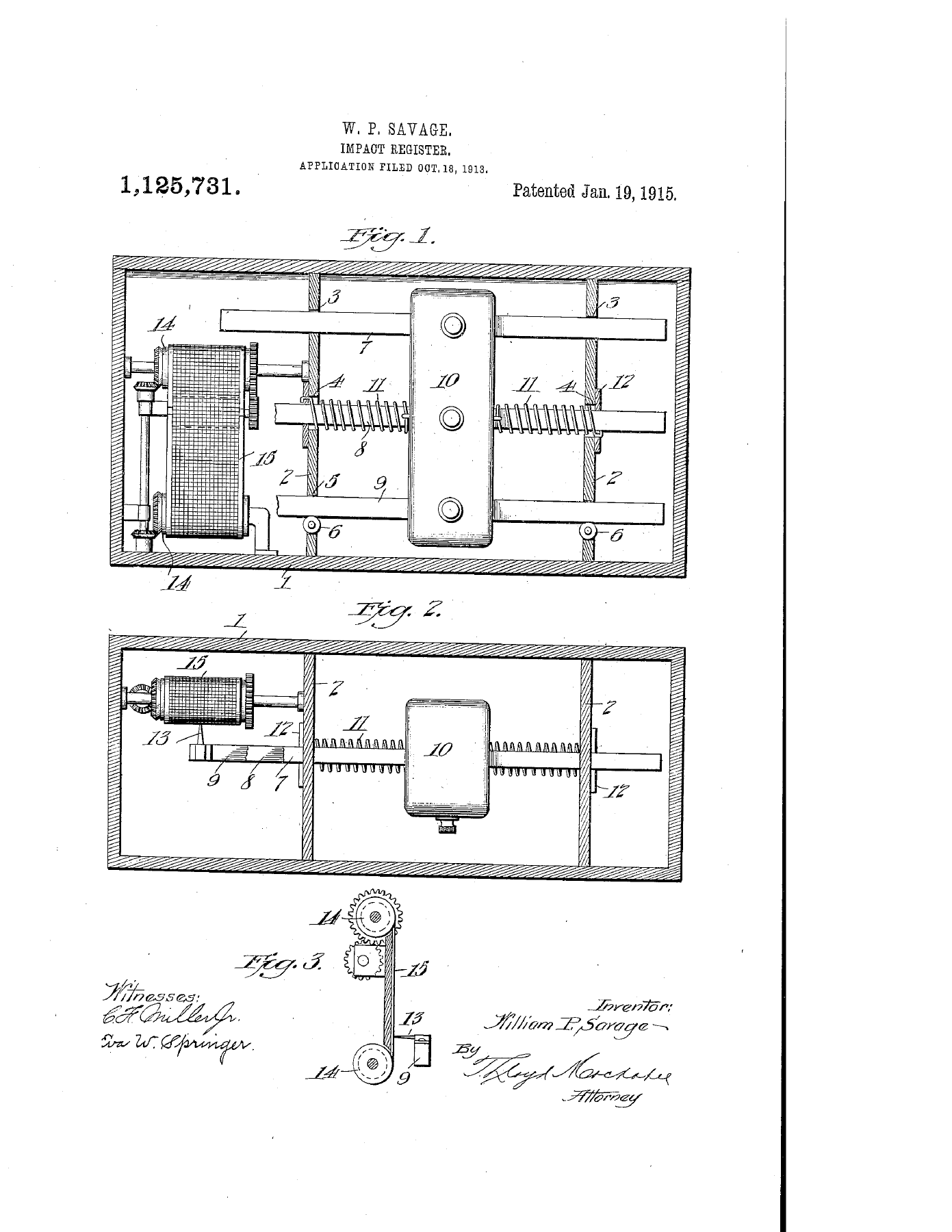
W. P. Savage's Impact Register
U.S. Patent No. 1,125,731
- Application filed
- October 18, 1913
- Patent issued
- January 19, 1915
The drawing shows the chart drum, spring-mounted mechanism, and recording stylus in three views.
View the original drawing (PDF) →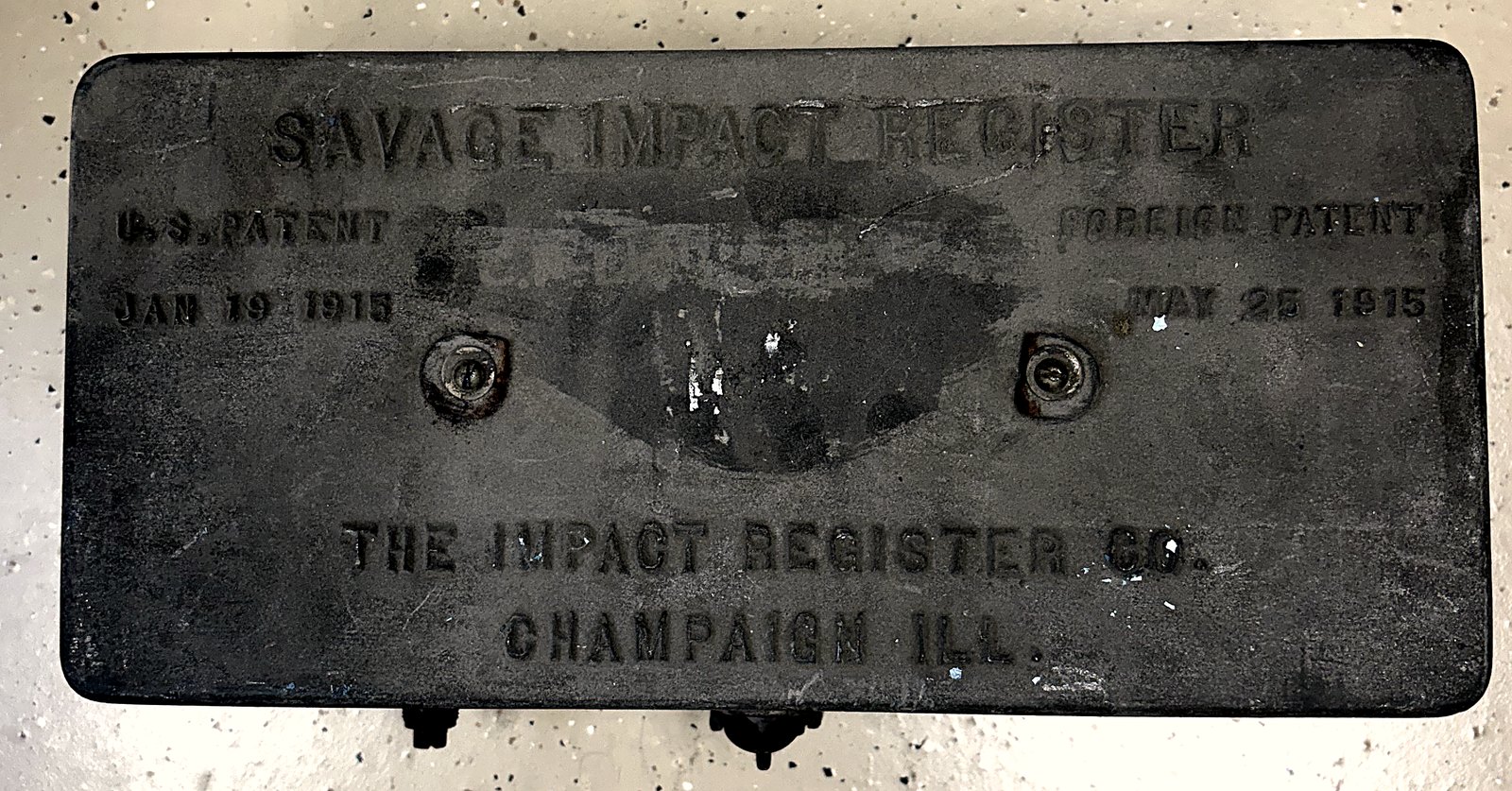
The men who ran it

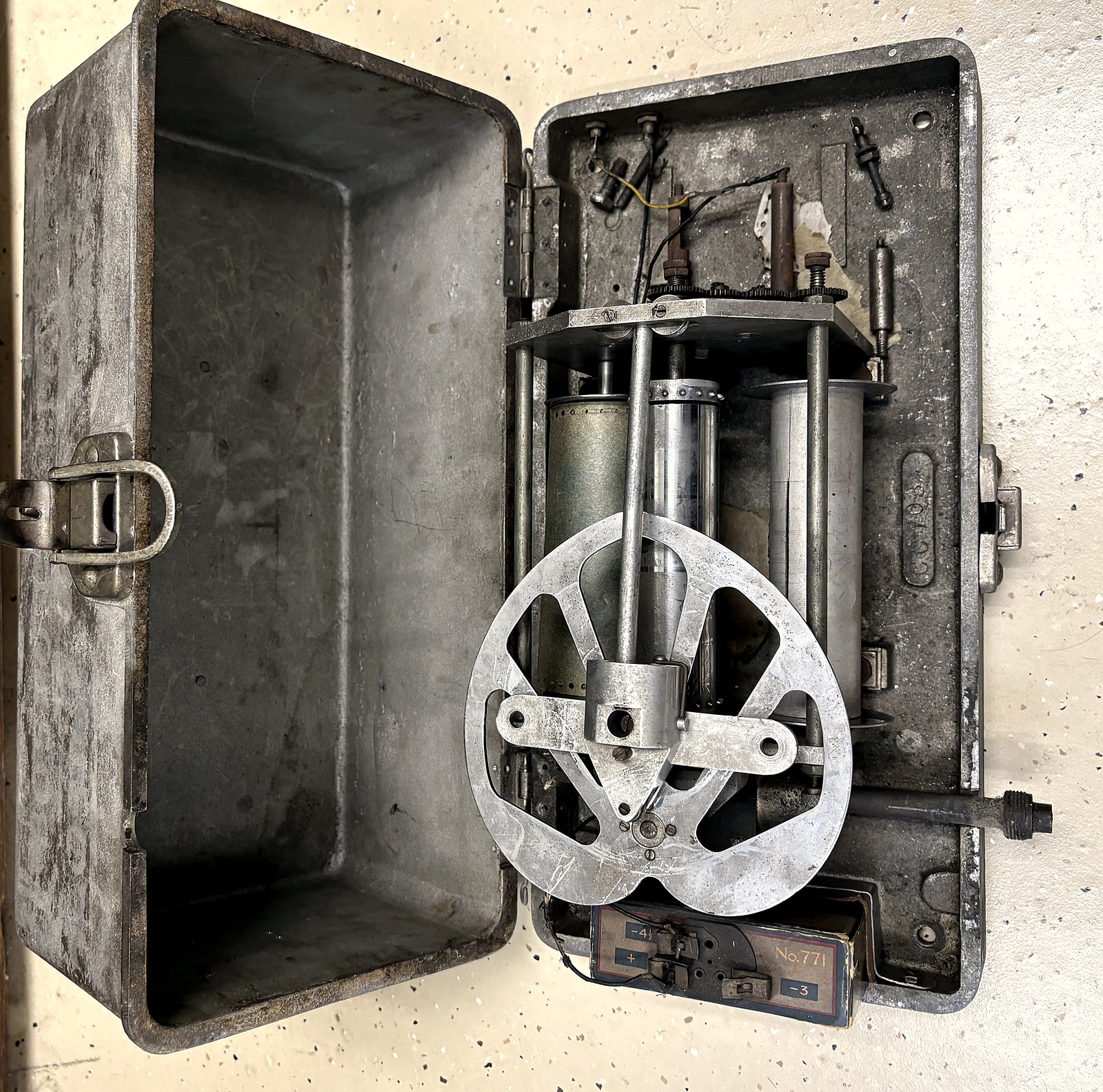
By 1925 the business was operating from 714 Champaign Street as a business trust, with E. W. and L. W. Savage as president and vice-president in Chicago, and William S. Redhed as secretary, treasurer and manager on the ground in Champaign. Its instruments recorded the force of impacts and the time they occurred, and they were sold to leading North American railroads and to shippers of fragile merchandise.
The Savage Impact Register Company is represented in the Smithsonian’s National Museum of American History, reflecting its place in the history of the railroad.
A second generation, and a better instrument
By the early 1960s the company had become The Impact Register Company, still in Champaign, and had moved to a fundamentally better instrument: a damped accelerometer that records the acceleration a shipment actually experiences, continuously, rather than merely registering the speed of a coupling.
In April 1961 the company commissioned a technical study from David D. Redhed, a second generation of the family that had run the company since at least the 1920s. He was a mechanical engineer trained at Ripon, MIT and the University of Illinois. His thirty-seven pages set his family’s company on a new course during the post-war economic boom. He worked out the mathematics that still governs the instruments: how heavily to damp a recording mass, how to choose its natural frequency, and what a mechanical instrument can and cannot honestly claim to measure. Those conclusions remain the technical basis of the product line, and passages from the study still appear, nearly verbatim, in the company’s published literature.
Redhed went on to Boeing, where he became a contributor and author on IPAD, a NASA-funded effort to integrate computer-based engineering analysis and design into a single, connected workflow. Long before today’s integrated CAD, simulation and digital-engineering platforms, IPAD explored how engineers could use computers not merely to perform calculations, but to coordinate the entire process of designing complex products. In that sense it belongs to the same technological lineage that eventually led to modern CAD/CAE suites and today’s digital-twin platforms. In 1978 Redhed also wrote about the importance of user interfaces in making advanced computing systems practical for industry — a concern that remains central to engineering software today.
Florida, and the years since
In December 1968 the business was incorporated in Florida as Impact Register, Inc. and settled in Largo. It was led for decades by Edward C. Manthei, a 1938 mechanical engineering graduate of the University of Illinois and a consulting engineer whose other work included the Morton Plant and Shriners hospital projects. Manthei died in 2005 and was buried in Urbana, a few miles from where the company started.
It remains family-run today.
The Savage Impact Recorder
William P. Savage receives U.S. Patent No. 1,125,731 for the Impact Register, an instrument for recording impacts on railway cars. Freight damage stops being anyone's word against anyone's.
The railroad era
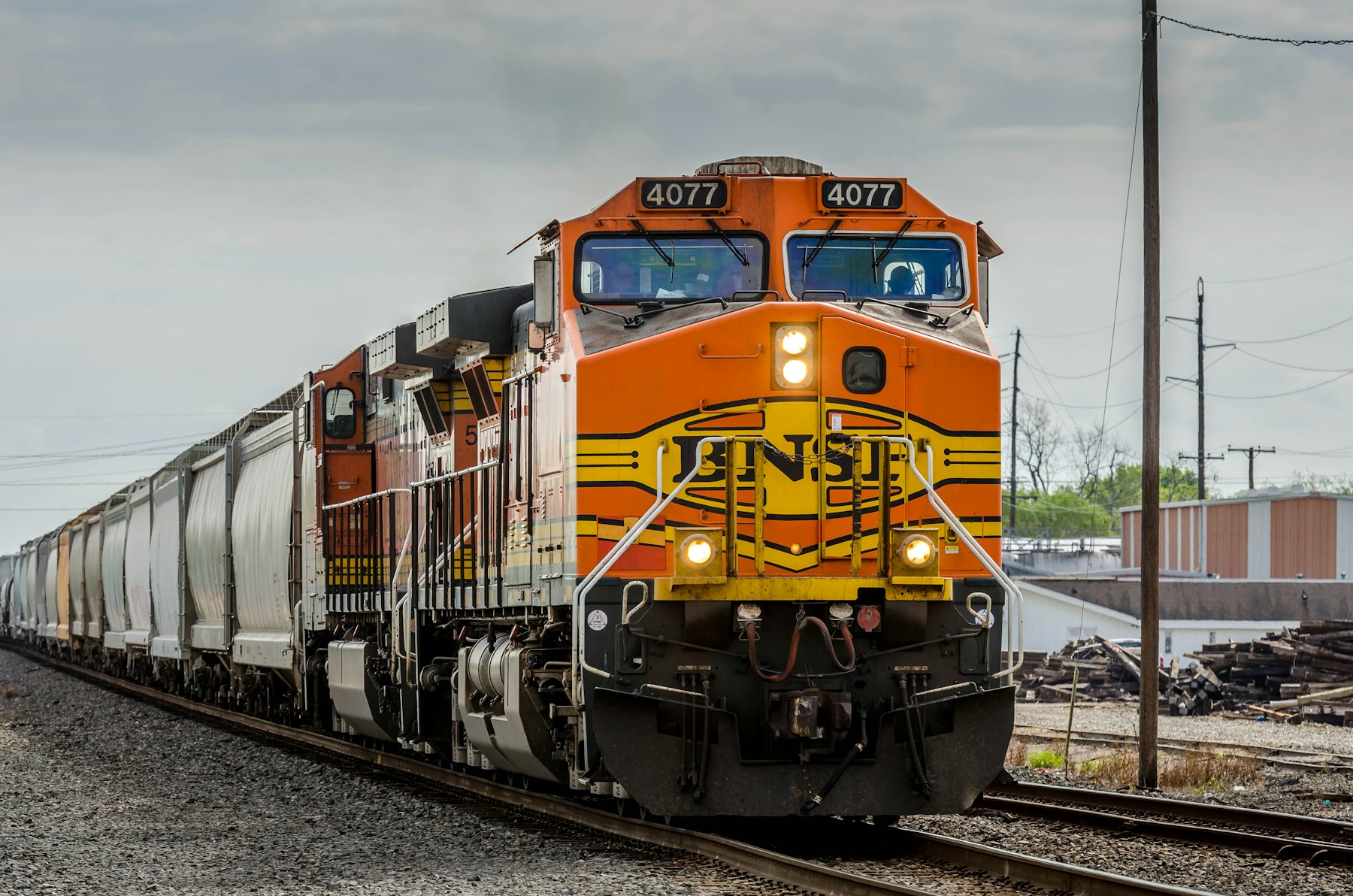
Impact recorders spread across American railroading. Coupling speeds go on the record; lading-damage claims begin to be settled by charts instead of arguments. The industry's largest library of impact measurement references begins here.
Trucks, ships, and missiles
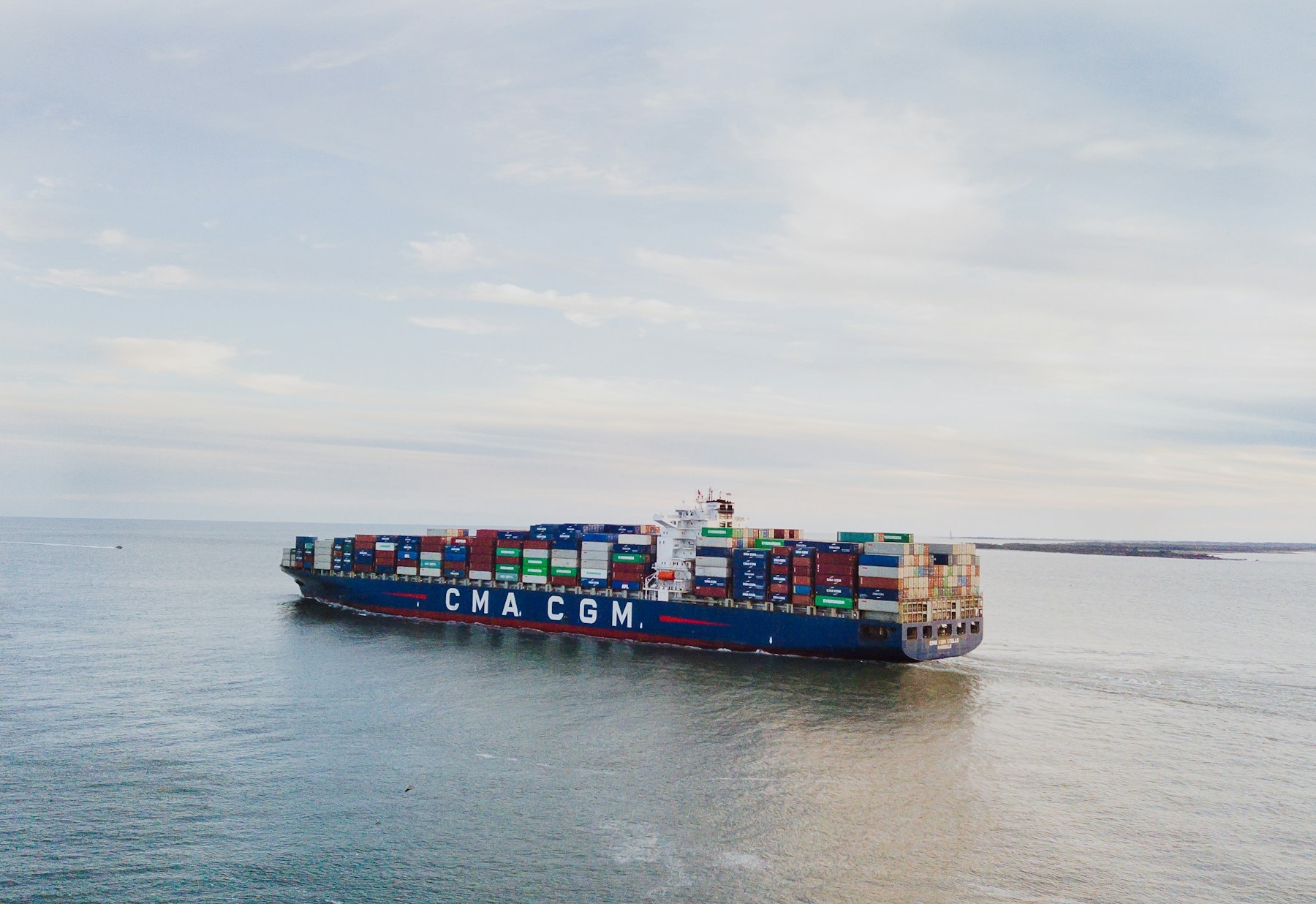
Mid-century expansion follows the freight: over-the-road trucking, ocean transits, and the acceleration measurement demands of the missile age. Impact Register instruments ride nose cones and laboratory test rigs alike.
The precision era
Machining tolerances reach 0.0001 of an inch. Static and dynamic calibration becomes standard practice. Recorders certified to within 4% of full scale become the reference instruments for packaging engineering and claims adjudication.
Accepted in litigation
Impact Register chart data, long used in damage-claim resolution, is accepted in lading-damage litigation, including numerous federal cases.
110+ years of continuous manufacture
Impact Register is positioned today at the center of the emergence of American manufacturing, a renewal driven forward by frontier technologies spanning artificial intelligence, outer space exploration, defense and its various applications.
Experience you can build on.
Work with the company whose instruments have been recording what freight endures since the railroad era.
We supply direct, through packaging integrators who specify our instruments inside their crating, and through distributors in importing markets.